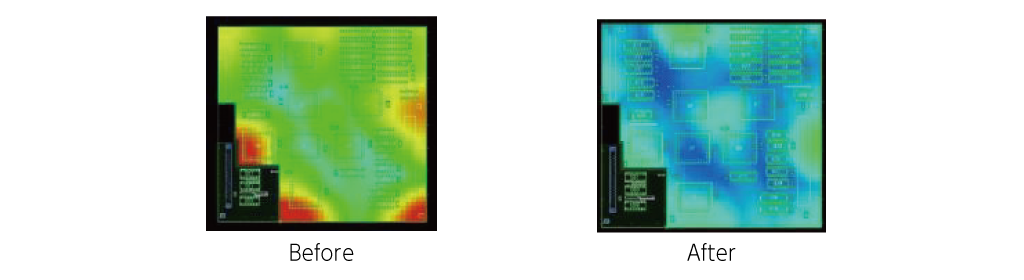
Visualizing design quality
Supporting the optimization of development time and cost
By utilizing PCB simulation, we visualize and analyze challenges such as impedance, transmission characteristics,crosstalk, and EMI noise at the early design stage.
We prevent post-manufacturing defects and performance degradation risks in advance, achieving high-precision design without rework.
We support improvements in design quality with a view to mass production stability and product reliability, while achieving both shortened development periods and cost reduction.
Analysis Menu
SI Analysis (Signal Integrity)
By analysing transmission lines from the early design stage, we achieve optimal component placement and routing that preserves signal quality.This cuts wasteful cost and time during actual-equipment verification and eliminates design rework, supporting shorter development periods and lower costs.
EMI Analysis (Electro Magnetic Interference)
EMI analysis identifies and suppresses the sources of unwanted electromagnetic radiation (radiated noise/emissions) in advance, greatly reducing countermeasure time and cost after prototyping.Plane-resonance analysis identifies resonant frequencies on power planes and suppresses the resonance phenomena that cause noise and EMI; based on the results, we reshape the power plane or add capacitors as countermeasures.
Required documents: layer stack-up / signal frequency *2-layer boards are not supported
PI Analysis (Power Integrity)
Power-quality analysis evaluates input-impedance characteristics and IR drop to ensure stable power delivery to ICs.
Input Impedance Analysis
We evaluate frequency characteristics and keep impedance below the target value by reshaping the power plane or adding capacitors, improving noise immunity.
Required documents: target impedance of the IC / IC voltage and current consumption (mA) / layer stack-up / S-parameters of each capacitor (held in-house)
IR Drop Analysis
We quantitatively evaluate the voltage drop along current paths to secure each IC's operating voltage, adjusting the power-plane shape and the number of vias to prevent malfunctions caused by voltage drop.
Required documents: current and voltage values of the power net / layer stack-up / allowable voltage-drop range
Electromagnetic Field Analysis (via Partner)
In collaboration with partner companies, we precisely analyse and improve the transmission quality of high-speed differential signals and more.
TDR Analysis (Time Domain Reflectometry)
We analyse and adjust the impedance of pads and vias. When the pad width differs greatly from the trace width, we remove the GND directly beneath the pad or adjust the clearance to the surrounding copper around vias to eliminate impedance discontinuities and match impedance.
Required documents: layer stack-up / signal speed / routing-layer designation / via diameter / component land shape, etc.
Return-Loss Analysis (S11 / S21, etc.)
We evaluate S11 (reflection) and S21 (transmission) and graph how much of the signal is reflected and transmitted. Where issues are found, we re-adjust trace impedance, pad clearances, and similar parameters to improve them (differential signals are evaluated with SDD11 / SDD21).
What types of PCB simulation analysis do you support?
In addition to SI (Signal Integrity), EMI (Electro Magnetic Interference), and PI (Power Integrity) analysis, we also offer electromagnetic field analysis (TDR and return-loss analysis) through partner collaboration. We visualise and analyse signal quality, unwanted electromagnetic radiation, power quality, and transmission characteristics at the early design stage, reducing the risk of costly rework after prototyping.
What are the benefits of requesting PCB simulation analysis?
By detecting impedance mismatches, transmission issues, crosstalk, and EMI noise early in the design process, you can prevent defects and performance degradation after manufacturing, resulting in higher-quality designs and shorter development cycles with reduced costs.
Which interfaces and devices do you have experience analysing for SI (signal integrity)?
We have experience analysing DDR2/DDR3/DDR4 and LPDDR2/LPDDR3/LPDDR4 memory buses and high-speed interfaces such as PCI-Express Gen4 and 12G-SDI, as well as FPGAs, SoCs, and MCUs from vendors including Altera (Intel), AMD (formerly Xilinx), NXP, Qualcomm, Renesas, Texas Instruments, and STMicroelectronics. Please contact us for more details on your specific requirements.
Can I request PCB design and simulation analysis together?
Yes. PCB design and simulation analysis are handled together at the same facility. By integrating design and analysis, we improve design quality and minimise the need for rework during prototyping.
How do I request a quote for simulation analysis?
Please contact us via the inquiry form or estimate request form on our website. Once you share details about your circuit and PCB specifications, our team will follow up to propose the most suitable approach.